
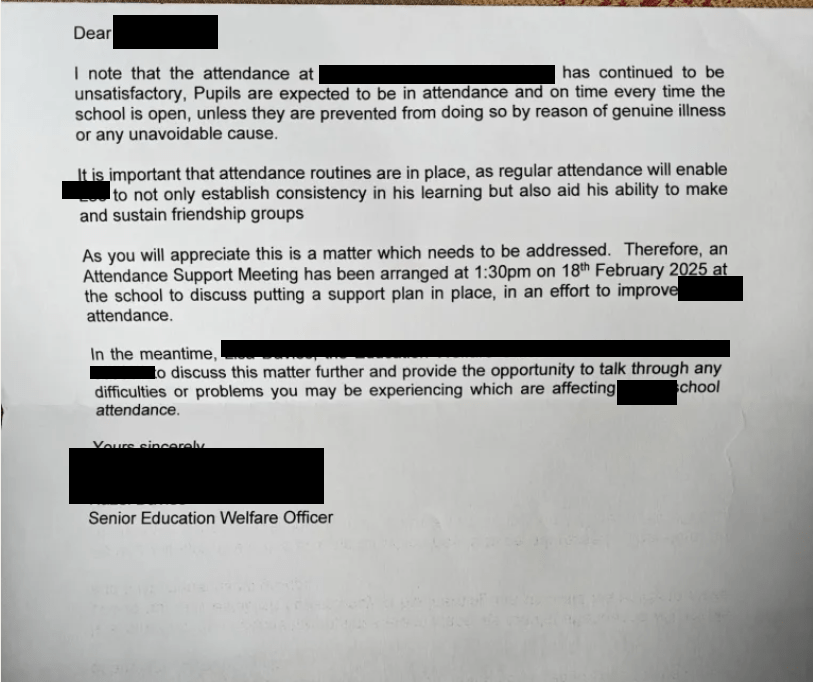
I knew this was coming, but this letter arrived this week.
This had been rumbling on for some time. That fateful phone call from the EWO (Am I Managing Stress and Anxiety, or Just Surviving?) had prompted me to write an email to her and the school, detailing everything I had done over the last two years and requesting that all communication be in writing. It took the EWO two weeks to reply, not that I was particularly waiting on it, and when she did, her response was a complete backtrack on everything she had said verbally. School never responded at all.
Then, my son’s dad told me that school had been calling him for updates, as had the EWO. Divide and conquer eh. Since they weren’t getting the response they wanted from me, they had turned to him. I decided to let it play out, to see where it led—if nothing else, it gave me a brief respite from the constant battle. I carried on, getting my son to school when he was ready and able, and pushed it all to the back of my mind.
Until the 4th of February. On that day my son’s dad told me the EWO had scheduled a meeting at school for the 18th. I hadn’t been invited. I left it at that and tried not to let it bother me. But it did.
What was going on here?
Why wasn’t I invited?
Were they sidestepping me?
Was this their way of ousting me as my son’s parent?
Eight days after first hearing about the meeting, I received an email from the EWO confirming it would take place on Tuesday, the 18th of February, in the afternoon. The afternoon. No actual time. She also said she would send out a letter that day, the 11th of February. I waited. And waited. The letter finally arrived on the 17th. Dated the 12th, postmarked the 13th. A letter informing me of a meeting the next day. Clearly, my request for written communication had annoyed the EWO so much that she’d decided to use carrier pigeons as the mode of delivery.
And honestly, I don’t know how I felt about it all. Stunned. Disbelieving. Holding myself together on the outside, but inside, I felt vulnerable. Scared. I have to walk into that meeting with school, the EWO, and my son’s dad—each of them believing I’m the problem—and prove that I’m not. That it’s not my parenting. That my son needs support.
I’m a strong person. I’ve faced my share of battles. But am I strong enough for this? As I write this, I feel like I’m falling apart inside. For all my jokes and my ability to laugh things off, I am slowly crumbling. But to the meeting, I must go.
I had my file. My notes. My Pukka Pad. I asked my Instagram followers for song recommendations for the drive to school, made my playlist, and set off. As I drove, my eyes filled with tears, my throat tightened. Could I do this? Could I keep it together? Could I challenge the EWO and, most importantly, stay calm?
I parked, walked to the school gate. My legs felt like lead, my feet too big, too clumsy. But I reached the gate, got buzzed in. At reception, I struggled to sign in, acutely aware of the receptionist watching me, likely thinking, “Oh, here’s that parent.” I was ushered to the waiting area. My son’s dad was already there. We exchanged polite greetings, then silence. My hands were shaking, my legs weak.
Breathe. Breathe. Breathe.
The headteacher appeared and invited us in. The meeting began.
And what a tough crowd. Me, against the head, the SENCO, the EWO, and my son’s dad. My stance was clear: my son is neurodivergent. A high masker. My home is his safe space. The son I know is autistic with a PDA profile, possibly ADHD. The son they see isn’t. They can’t explain why he’s different at my house—though they try to pin it on me—but I can explain why he is different everywhere else: he is masking. My theory fits. It explains everything. Yet they won’t listen. Or rather, they listen, then dismiss it.
The EWO asked what school currently had in place.
Back in November, I had worked to implement adjustments to my son’s day. One major change was allowing him to go for an early lunch with his best friend. It started the week of November 18th. Before this, he had only managed one Wednesday in school that term. After the change, he attended three consecutive Wednesdays and even had two full weeks of perfect attendance. It was a breakthrough. I told the school this in a meeting just before Christmas, crediting the early lunch for the progress.
Then, after Christmas, everything fell apart. Attendance dropped. School hadn’t reached out, so I assumed the early lunch was still in place and that maybe my son was just recovering from Christmas. But in this meeting, I found out the truth. The early lunch had been cut—from ten minutes early to just two minutes early. Their reason? Missing those eight extra minutes meant he was falling behind.
No one had told me.
I had been trying to persuade my son to go to school, reminding him about his early lunch—something that wasn’t even happening. And for the sake of eight minutes, he had now missed more school than ever before.
I was speechless.
Then the EWO turned to me. “The attendance issues are only at your house, so we need to focus on that.”
“No,” I said. “We need to look at his life as a whole.”
Straight away, I knew I was up against it. And so it went—back and forth. Her against me.
EWO: “Have you tried rewards and punishments?”
(Oh, why hadn’t I thought of that!)
Me: “Yes, I’ve tried everything. Reward charts, punishments, discipline, persuasion. None of it works. In fact, it makes things worse. This isn’t my parenting.”
EWO: “Have you tried Early Help?”
(Not this again!)
Me: “Yes. They assessed both households and found nothing to explain what’s happening. They signposted me to SENDIASS and told me to push for an ASD/ADHD assessment.”
EWO: “Have you spoken to Daisy Chain?”
(Oh, for the love of—)
Me: “Yes, and they’ve been fantastic. But they can’t change the school environment can they?”
And once again I launched into the same speech I had told a thousand times…..
For two and a half years, I have forced my son into school at a cost to him, myself, and my family. He has hit me. Hurt himself. We’ve nearly crashed the car. I have dragged him into the car and then out again. The school has even come outside to try and get him in. We’ve arrived at the gates in floods of tears. And I refuse to put my son—or myself—through that any longer. I asked them, “Do we all agree that mornings shouldn’t be like this?”
Silence.
The EWO looked at me. “What do you think?”
I stared back. “I’m asking you. Do you think we should continue like this?”
She leaned forward. “No! I’m asking you—do you think you should continue with mornings like that?”
Really? Really? Where was the humanity? The compassion? But the moment passed, and she moved the meeting on.
We discussed the challenges highlighted in the OT report. The SENCO mentioned that handwriting practice took place on Mondays, Tuesdays, and Wednesdays. I pointed out that my son’s difficulties with fine motor skills—his struggle with handwriting, his deep dislike of it—aligned exactly with the days he wasn’t coming to school. It wasn’t just about being with me. His absence finally made sense……to me at least. To the one who understands what he is going through.
We got to the end of the meeting and the EWO asked if anyone had any further questions. This was my time to shine. I said yes I did.
“Please could you clarify what counts as a ‘genuine illness’?”
The look she gave me was one of absolute disdain. But I had started this, and I wasn’t about to stop now. She told me a genuine illness was one we all recognise—chickenpox, sickness, diarrhoea. I pointed out that these were physical illnesses….
“Is a mental illness considered a genuine illness?”
“Yes,” she said. “But only if diagnosed by a doctor.”
I asked if anxiety was a mental illness.
“Yes,” she repeated, “if diagnosed by a doctor.”
“So do I need to get my son diagnosed with anxiety?”
“That’s up to you.”
“Do you need me to get him diagnosed with anxiety?”
Again, she replied, “That’s up to you.”
I wasn’t looking for an argument. I was looking for guidance, some kind of direction in this impossible situation. But she was acting like a politician—dodging, evading, refusing to commit to anything. And in actual fact I think the reality was that she had no idea what to say. She didn’t know what to do. I told her how utterly unsupportive I found the letter they had sent. As a parent, I had tried my absolute best—my absolute best—in incredibly challenging circumstances. And yet, the letter implied that if my son didn’t attend school, he might not make friends, or that he didn’t have a genuine illness. Reading that, after everything, was gut-wrenching.
And do you know what she said?
She told me it was me with the barrier up. That my reaction to the letter was the problem. That I was too focused on the sentences in the letter instead of my son.
But I had said my piece. I reiterated that I had no barrier up. I simply wanted them to understand how harmful their wording was—how, to parents who are already giving everything, it was soul destroying. Then she asked,
“Do you feel supported in this meeting?”
I almost laughed.
“I’ll have to let you know once I’ve had time to process everything.” But the truth? No. Not at all.
I walked out feeling… okay. I was getting better at handling these meetings. But two hours later, when the adrenaline wore off, I crashed. Hard.
By bedtime, I couldn’t sleep. And when I finally got up the next morning, I threw up in the kitchen sink. My head was pounding. I knew, then and there, that I needed time to recover. These meetings weren’t just difficult. They were traumatic.
I cancelled my beloved yoga class. Ironically, yoga was probably what I needed most, but I could barely lift my head off the pillow.I cancelled my daughter’s maths tutor (which she was very pleased about!!). I was becoming increasingly flaky, and I hated it. But I couldn’t stop it. And I spent 48 hours holed up in the house. I didn’t want to see anyone. I didn’t want to face the world. I wanted everything to go away. I just wasn’t able at this point in time to continue with life. I needed things to stop.
The problem is…..this rollercoaster had no brakes. No way to slow down. No way to stop. No way off.
And all I could do was keep riding it—throwing up along the way.


 The Questions of My Child
Leave a reply to Christopher Marcus Cancel reply